Prioritize Proximity
Favor warehouses closer to the project destination to reduce expected travel distance.
Case Study
Turning a manual multi-warehouse sourcing process into a cost-based decision system.
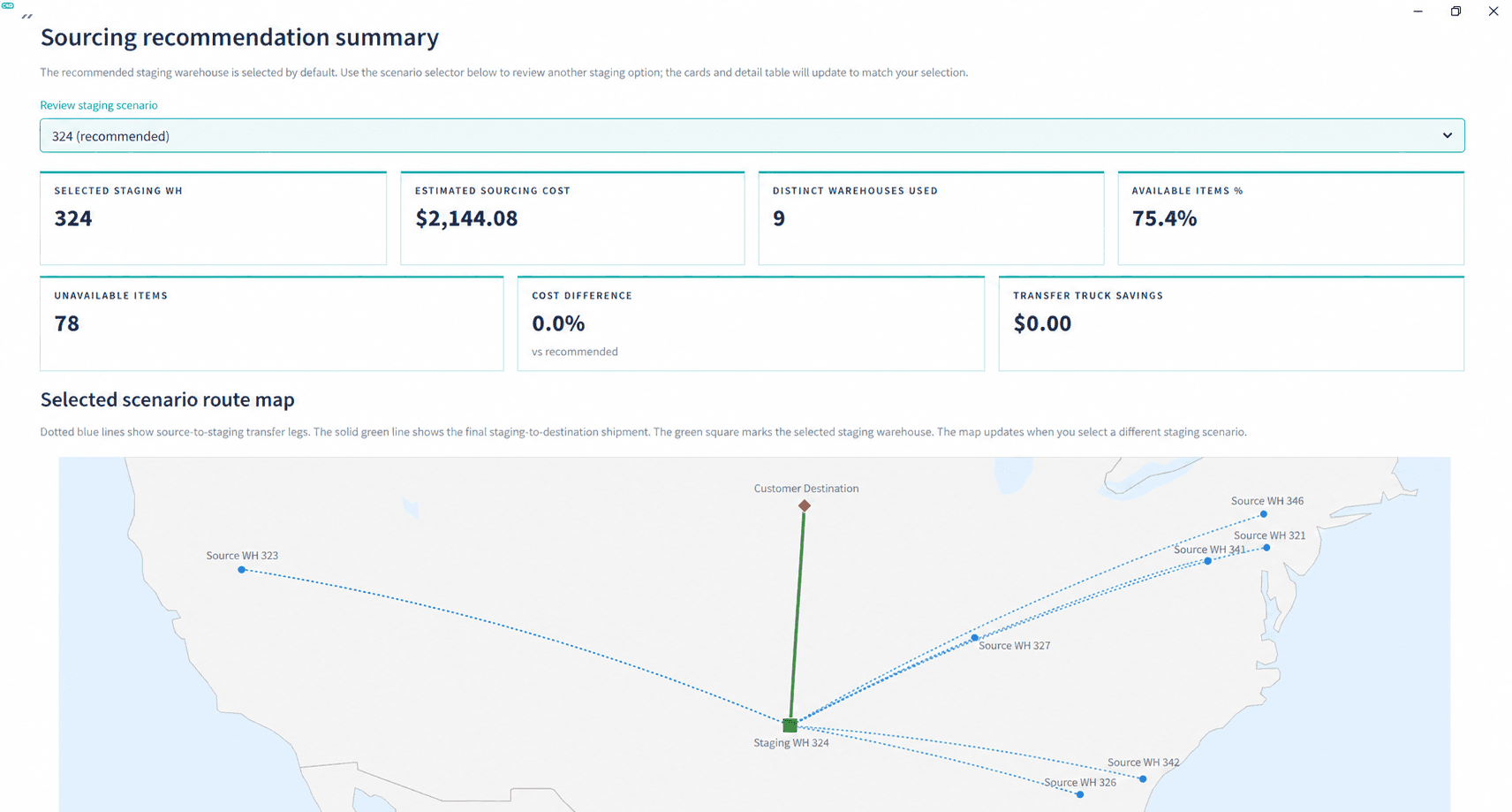
Overview
Project fulfillment coordinators previously relied on manual inventory checks and warehouse-by-warehouse comparison to build sourcing plans for large project orders that required additional coordination, consolidation, and fulfillment oversight.
I designed and built a Python-based decision-support application that evaluates inventory availability across the warehouse network, constructs sourcing and staging scenarios, estimates logistics costs, and recommends a cost-efficient fulfillment plan. The resulting workflow gives coordinators a faster and more consistent basis for sourcing decisions while preserving the ability to review alternative scenarios and operationalize the selected plan.
01
Preparing a sourcing plan required determining where inventory should come from across the warehouse network and where the order should be consolidated before final shipment.
Favor warehouses closer to the project destination to reduce expected travel distance.
Source from fewer warehouses to reduce the number of transfers required before final shipment.
The opportunity was to put those alternatives on the same cost basis and give coordinators a consistent way to identify the most cost-efficient sourcing configuration.
02
The application turns the sourcing decision into a structured scenario evaluation. The user enters a primary project order and, when needed, related orders that should be fulfilled together. The tool consolidates the required demand, evaluates inventory availability across the warehouse network, and builds sourcing plans across the available staging locations.
For each scenario, the Python engine determines the required source-to-staging movements, taps into an internal shipping-cost calculator API to estimate the cost of those transfers and the final shipment to the customer, applies relevant business rules, and ranks the resulting scenarios by total estimated sourcing cost.
03
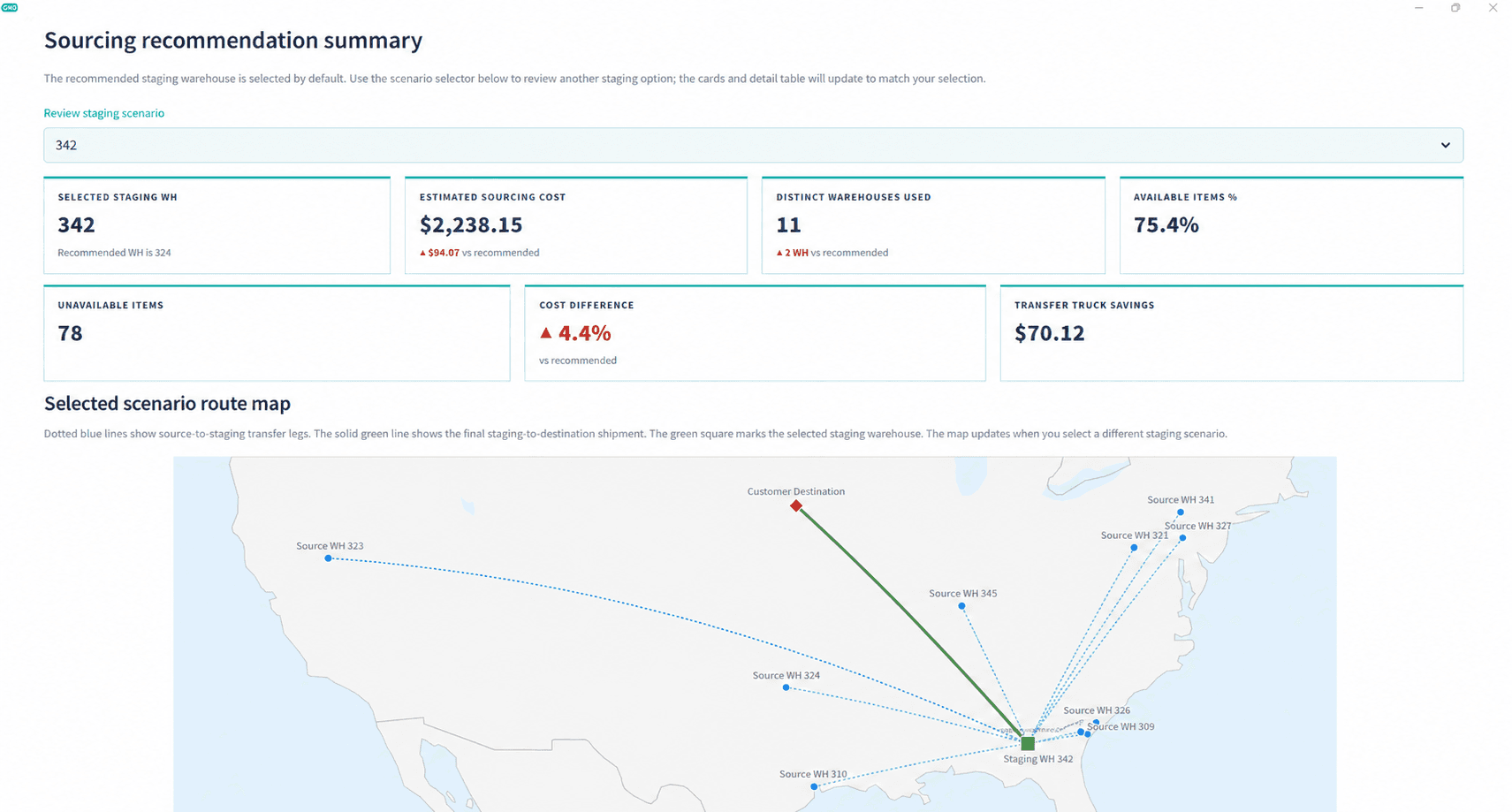
The recommended plan remains transparent and reviewable. Users can select another staging scenario and immediately compare its estimated cost, warehouse requirements, inventory availability, transfer savings, and route structure against the recommended option.
Example Scenario
The comparison gives users a clearer basis for deciding whether an operational preference justifies the additional cost.
04
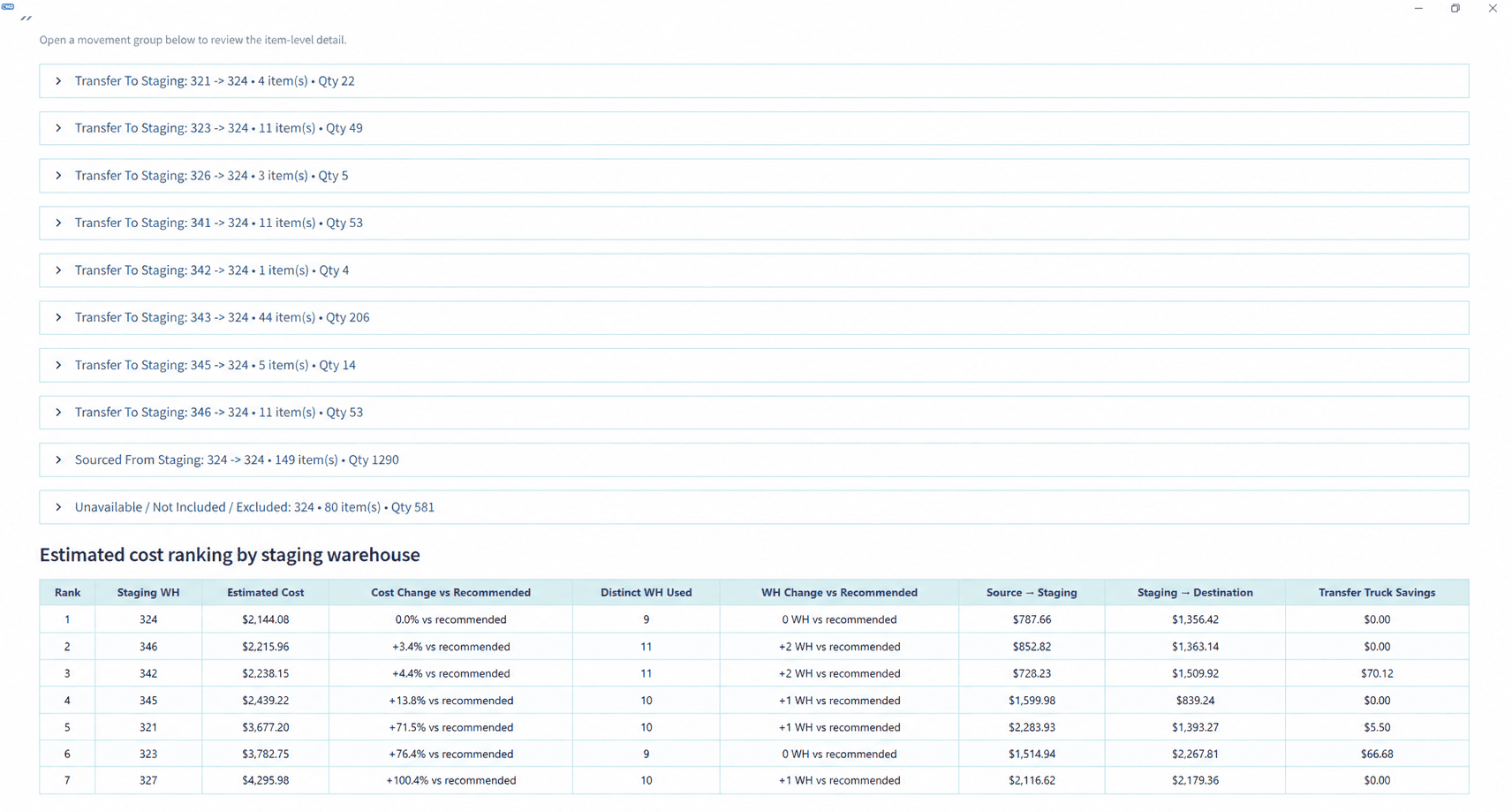
Beyond the recommendation itself, the application exposes the warehouse movements, item-level detail, quantities, and estimated transfer costs behind the selected sourcing plan.
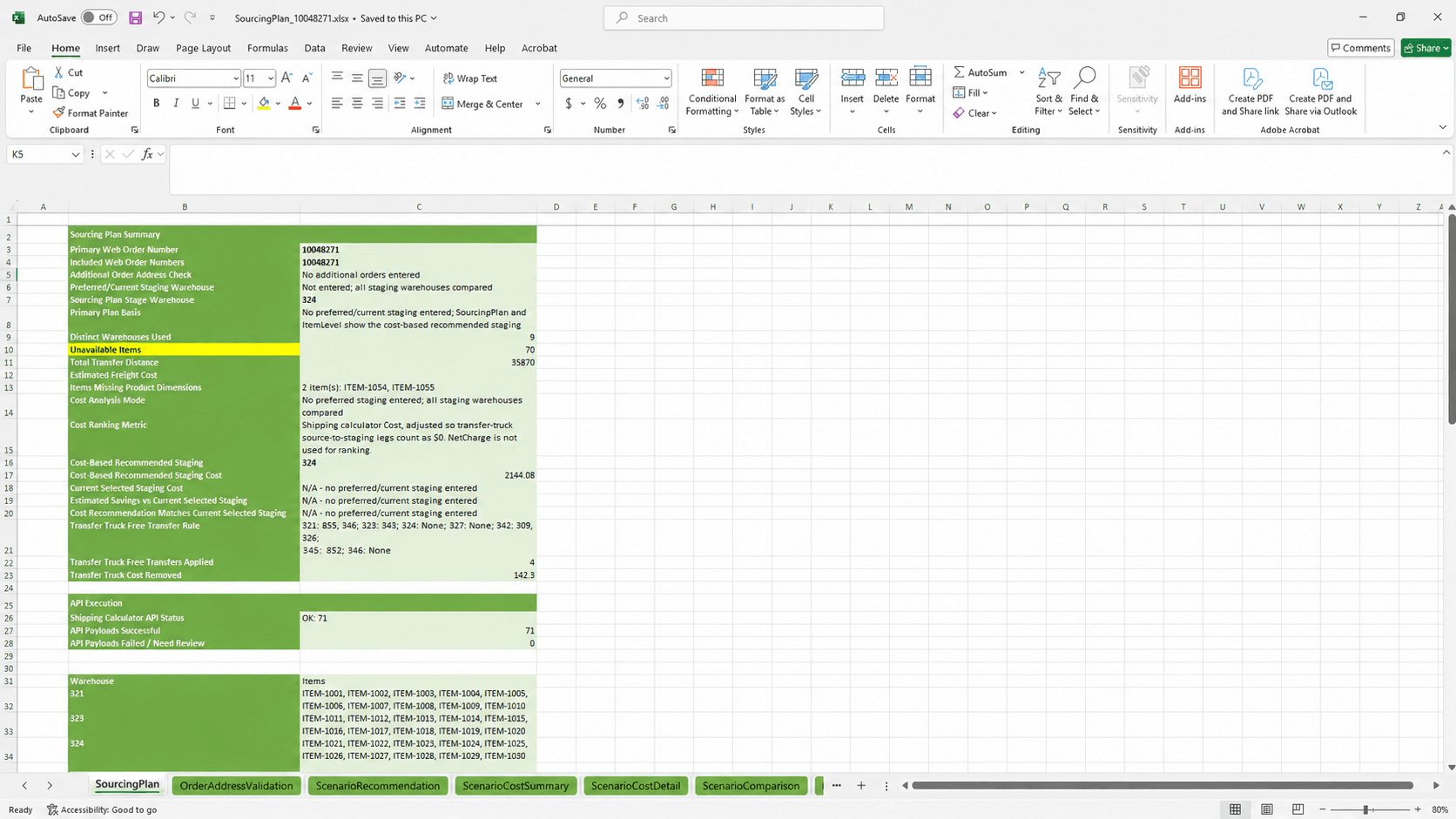
The user can also generate an Excel export containing the output at multiple levels of detail, making it easier to carry the sourcing plan into the team's downstream operational workflows.
Business Impact
Early use reduced sourcing-plan preparation from roughly a full workday to about one hour per project.
Sourcing alternatives are evaluated against a common estimated-cost framework rather than individual heuristics alone.
Users can see how transfer costs, final-shipment costs, and alternative staging choices affect the overall sourcing plan.
05
The solution combines enterprise data preparation with a Python-based sourcing engine, an internal shipping-cost API, and a Streamlit application used to evaluate and operationalize sourcing scenarios. AI-assisted development accelerated parts of the Python build while the business logic, workflow design, decision rules, and implementation remained grounded in the sourcing process I designed.
Order, inventory, warehouse, and product data are transformed into an item-level structure that the engine can use to build sourcing scenarios, estimate transfer and final-shipment costs, apply operational business rules, and rank the resulting plans. The selected scenario can then be reviewed in the application and exported into a structured Excel sourcing plan for downstream use.
Continue Exploring
Additional case studies focused on profitability and enterprise sales reporting are currently being prepared.
Back to Work